


ORIGIN · KENYA
Kenyan Coffee
Highland grown. Brightly expressive. Distinctly Kenyan.
Every coffee Kenya exports is Arabica, grown on the highlands that ring Mount Kenya and reach west towards Mount Elgon. Most of it is raised by smallholding families, washed at a cooperative's own factory, then graded and sold at auction in Nairobi. That system is unusually rigorous, and it is a large part of why Kenyan coffee tastes the way it does. This is a guide to where it grows, what the grades actually mean, and the Kenyan coffee we roast.
EXPLORE THE ORIGINTHE COFFEE HIGHLANDS
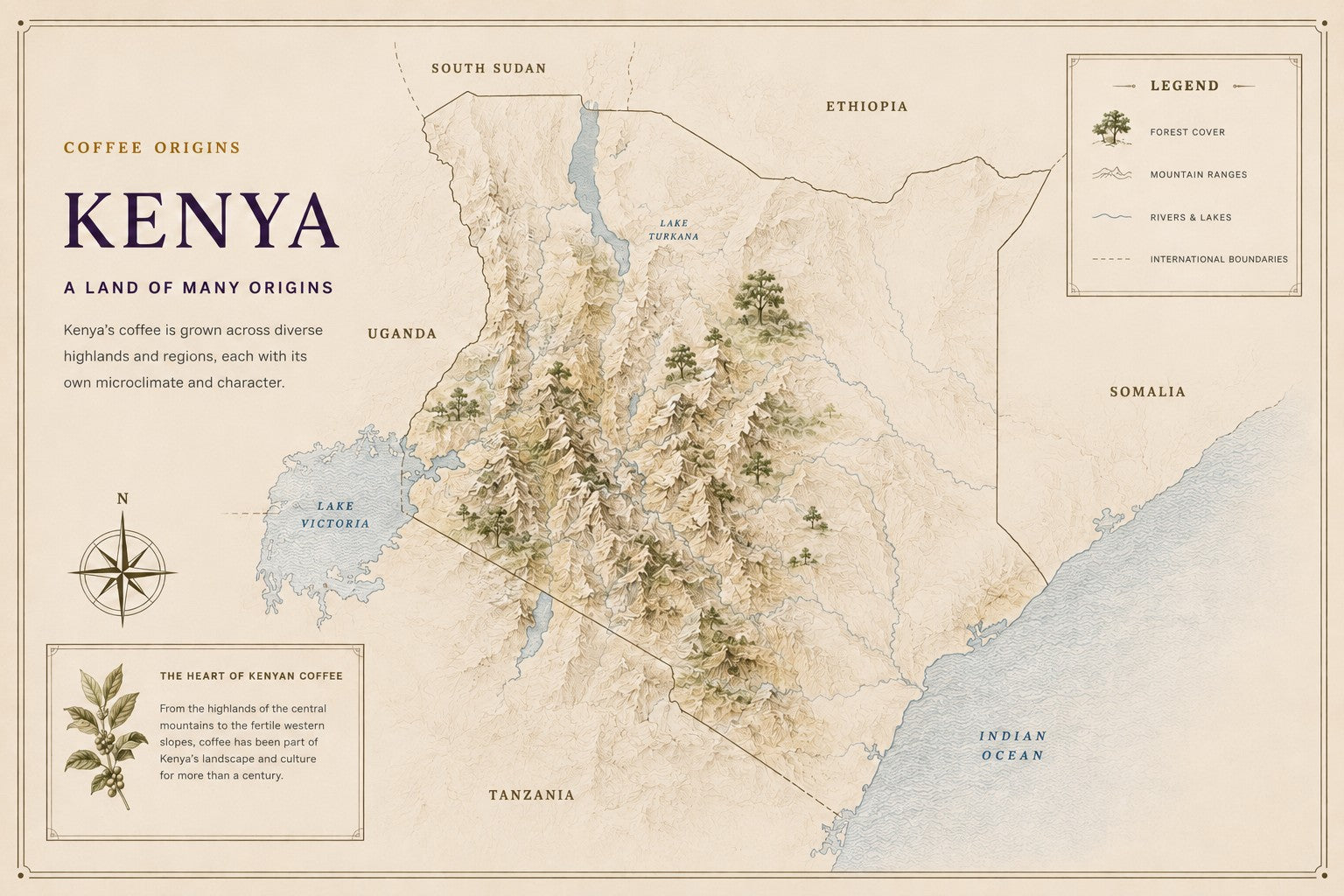
Where Kenyan coffee grows
Kenya grows coffee in more than thirty counties, but production concentrates in the highlands around Mount Kenya and the Aberdare range, where volcanic soils and two rainy seasons suit Arabica particularly well. A second, smaller belt runs west through the Rift Valley towards Mount Elgon.
The areas below are ordered by how much coffee they produce. Kirinyaga and Nyeri lead.

-
KIRINYAGA
Southern slopes of Mount Kenya. The country's leading coffee county, with a dense network of cooperative factories.
-
NYERI
Between Mount Kenya and the Aberdare range. Long associated with Kenya's most structured, blackcurrant leaning coffees.
-
MURANG'A
South west of Mount Kenya, on the eastern slopes of the Aberdares. A large smallholder county with a long coffee tradition.
-
KIAMBU
The highlands north of Nairobi. Historically Kenya's estate county, and among those where coffee land has given way to housing.
-
KERICHO
West of the Rift Valley and better known for tea. A significant coffee producer that is often overlooked.
-
EMBU
South eastern slopes of Mount Kenya, where the highlands fall away towards drier country.
-
MERU
North and east of Mount Kenya. High, cool and comparatively remote.
-
MOUNT ELGON
The western highlands on the Ugandan border. A separate belt from the Mount Kenya counties.
Areas shown are coffee growing areas as the trade knows them, ordered by share of national production. They are not administrative boundaries, and the base map is illustrative.
ALTITUDE, SOIL AND METHOD
What shapes the Kenyan cup
Kenyan coffee is recognisable in a line-up, and that is not an accident. Four things about the way it is grown and processed push it consistently in the same direction.
High and cool
Kenyan coffee generally grows between about 1,400 and 2,000 metres. Cherries ripen slowly at that altitude, which builds the acidity and the sugars the origin is known for.
Volcanic soils
The highlands around Mount Kenya and the Aberdares carry deep, well drained volcanic soils that hold nutrients without waterlogging the roots.
Two rainy seasons
Kenya has two rains rather than one, which gives a main harvest and a smaller secondary one. Most of the quality lots come from the main crop.
The washed tradition
Kenyan coffee is overwhelmingly wet processed. Cherries are pulped, fermented and washed at the cooperative's factory, then dried on raised beds. That method is much of the clarity in the cup.

THE VARIETIES
SL28, Ruiru 11, and a coffee named after a mountain
Kenya's reputation was built on SL28 and SL34, two selections made at Scott Laboratories in the 1930s and still prized for their acidity and fruit. Both are vulnerable to coffee berry disease and leaf rust, so Kenya's Coffee Research Institute bred alternatives: Ruiru 11, and then Batian, released in 2010 and named after the highest peak on Mount Kenya.
Most Kenyan farms now grow a mixture of these. Which varieties are in any given lot depends on the farm, and it is not something a grade can tell you.
BEYOND THE LETTERS
Understanding Kenya's coffee grades
Kenyan coffee is sold by grade, and the letters turn up on bags all over the world. They are worth understanding, because they describe something real. They simply do not describe what most people assume.
Grading happens at the mill, after the coffee is dry. Beans are sorted by size, by shape and by density, then assessed for defects and for cup quality before a lot can be catalogued for sale. The letters record the sorting, not the verdict.
Sorted by bean size
 E
EElephant
The largest beans of all, and comparatively rare. Often two beans that have fused together.
 AA
AAThe largest standard grade
Kenya's best known grade and the largest of the sizes routinely traded. Screen sizes are measured in sixty fourths of an inch.
 AB
ABThe most common grade
A and B beans combined, one size band below AA. A large share of Kenya's crop sells as AB, including many outstanding lots.
 C
CSmaller beans
Below AB in size, and less commonly seen on specialty bags.


Sorted by bean shape
 PB
PBPeaberry
A natural occurrence in which the cherry produces one round bean instead of two flat ones. PB is sorted out by shape, so it can come from any tree in the field.

Sorted by density, not size
 TT
TTThe lighter fraction
Not a small size. TT is the lighter beans separated out from AA and AB by density, usually on a gravity table.
-
T
Fragments
The smallest fraction, made up of broken beans and chips.

So does AA mean better coffee?
No, and the system does not claim that it does. AA describes how big the bean is. It says nothing about the farm, the variety, the picking, the fermentation or the drying, and those are what decide how a coffee tastes.
A carefully made AB from a good factory will beat an indifferent AA, and buyers who taste for a living know it. Large beans do roast more evenly and they command a premium at auction, which is why the letters carry commercial weight. Treat AA as useful information about a lot, not as a score.
BRIGHT, JUICY, STRUCTURED
What Kenyan coffee tastes like
These are tendencies rather than promises. Kenyan coffee covers a wide range, and any single lot depends on its farm, its varieties and how carefully it was processed.
- Blackcurrant, the note most often used to describe the origin
- Citrus acidity, frequently lime or grapefruit
- Ripe stone and tropical fruit in many lots
- A full, syrupy body rather than a light one
- Sweetness that carries through a long finish
Acidity is the thing people notice first. Done well, it reads as fruit rather than as sourness.
Our Kenyan coffee
Here is what is in our current Kenyan cup.
 Honey
Honey
 Lime
Lime
 Tropical
Our current Kenyan lot opens with honey sweetness, moves through a sharp lime acidity, and finishes on ripe tropical fruit.

FROM KENYA, ROASTED BY TWIGA
Kenya
- Honey
- Lime
- Tropical
AA is Kenya's largest screen grade, and this lot drinks with the structure that suggests. Honey sweetness meets a sharp lime acidity, with a tropical fruit finish that the medium roast leaves fully intact.
- Roast
- Medium
- Size
- 12 oz
- Grind
- Whole bean
- Certification
- USDA Organic
Current lot GRADE AA
SHOP KENYA100% ARABICA
Single origin Kenya. Arabica is the only coffee species Kenya exports.
SMALL BATCH ROASTED
Roasted in California and shipped whole bean.
CERTIFIED ORGANIC
USDA Organic certified.
HOW A LOT IS MADE
From cherry to grade
Grading is one step in a long chain, and it happens near the end. Knowing where it sits explains what it can and cannot tell you.
-

Cherry
Ripe cherries are picked by hand, usually over several passes through the same trees, and delivered the same day.
-

Factory
Kenya calls its wet mills factories. The cooperative's factory pulps the cherry, ferments it, and washes the parchment clean.
-

Drying
Parchment is dried slowly on raised beds, turned by hand and covered through the hottest part of the day.
-

Dry mill
Once it is dry, the parchment is hulled away to reveal the green bean underneath.
-

Grading
The green coffee is sorted by size, shape and density, then assessed for defects and for cup quality.
-

Auction
Graded lots are catalogued by licensed brokers and sold at the Nairobi Coffee Exchange, which has run since 1935.


Grading exists so that lots can be described consistently and sold at auction. It is a trading instrument first, and it is applied after every decision that shapes flavour has already been made.
BREW THE ORIGIN
How to brew Kenyan coffee
Kenyan coffee carries more acidity than most origins, and the point of brewing it well is to let that acidity read as fruit rather than as sourness. Grind fresh, weigh what you use, and keep the water hot. No method is objectively best. These four suit our medium roast, and the numbers are the ones we actually use.
Pour Over
1:16 · medium grind · 195 to 205°F
The clearest way to hear the citrus and the fruit.
French Press
1:15 · coarse grind · 195 to 205°F · four minutes
Heavier in the cup, and it leans into the syrupy body.
Drip
About 1:17 · medium grind · 195 to 205°F
Our starting point for a full carafe.
Cold Brew
1:5 by weight, as a concentrate · coarse grind
Steep 12 to 18 hours in the fridge. Sixteen is our starting point. Dilute to taste.
Every ratio here is by weight, and the Brew Guide has the full method for each, along with AeroPress.
COMMON QUESTIONS
Questions about Kenyan coffee
The things people most often ask us about this origin.
What is Kenya AA coffee?
AA is Kenya's grade for the largest beans in the standard sorting system. It describes bean size, not flavour and not quality. A Kenya AA is simply a Kenyan coffee whose beans were sorted into the largest size band before sale.
Does AA mean the highest quality coffee?
No. AA describes size, and size is only one of the things assessed. Kenyan lots are also graded on defect count and cup quality before they can be sold, and the farm, variety, processing and drying matter far more to how a coffee tastes. A well made AB can easily be the better cup.
What is the difference between Kenya AA and AB?
Size. AA is the larger band. AB combines the A and B sizes, one step below it. AB makes up a large share of Kenya's crop, and plenty of exceptional Kenyan coffee is sold as AB.
What is peaberry coffee?
A peaberry, graded PB in Kenya, forms when a coffee cherry produces a single round bean instead of the usual two flat ones. It happens naturally on any tree, and it is sorted out by shape rather than by size.
What does Kenyan coffee taste like?
Kenyan coffee is typically bright and fruit driven, with a pronounced acidity often described as blackcurrant or citrus, a full syrupy body and a long sweet finish. Individual lots vary. Our current Kenyan coffee shows honey, lime and tropical fruit.
Where is coffee grown in Kenya?
Mostly in the highlands around Mount Kenya and the Aberdare range, in counties including Kirinyaga, Nyeri, Murang'a, Kiambu, Embu and Meru, with a second belt running west through the Rift Valley towards Mount Elgon.
Why is Kenyan coffee so bright and fruity?
A combination of altitude, soil and method. Cherries ripen slowly between roughly 1,400 and 2,000 metres, volcanic soils feed dense beans, and Kenya's thorough washed processing keeps the cup clean enough for that acidity to read as fruit.
How should I brew Kenyan coffee?
Any method that gives a clean extraction suits it. Pour over at 1:16 shows the fruit most clearly, while a French press at 1:15 gives a heavier cup. Grind fresh, and weigh both your coffee and your water. Full recipes are in our Brew Guide.
CONTINUE THE JOURNEY
Every origin tells a different story.
Kenya is one of the four origins we roast. Each one tastes like the place it came from.