

ORIGIN · RWANDA
Rwandan Coffee
Grown across a thousand hills. Built cup by cup.
Almost everything Rwanda grows is Arabica, planted on small hillside plots between roughly 1,300 and 2,150 metres and carried to a washing station within hours of picking. Altitude, Bourbon varieties and careful wet processing are what give the cup its clarity and its sweetness.
EXPLORE THE ORIGINTHE GROWING DISTRICTS
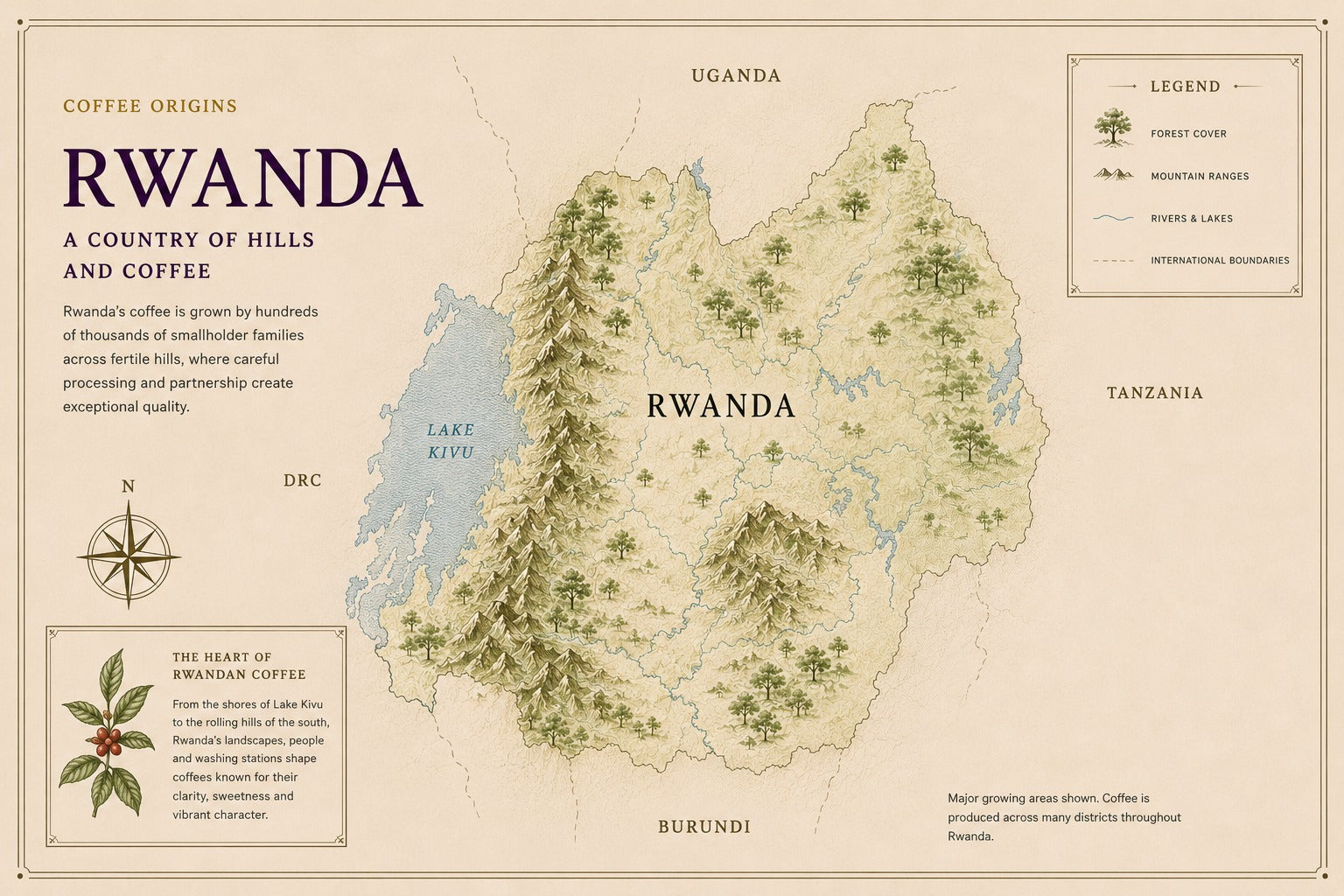
Where Rwandan coffee grows
Coffee grows in every district of Rwanda, usually on a fraction of a hectare alongside food crops. Production concentrates in the western districts along Lake Kivu, where the hills fall steeply to the water, and continues across the southern plateau and up into the northern highlands.

-
RutsiroLAKE KIVU
Steep hills on the northern stretch of the lake shore, with washing stations working at high elevation.
-
KarongiLAKE KIVU
Long frontage on Lake Kivu around Kibuye, and one of the districts prioritised for replanting old trees.
-
NyamashekeLAKE KIVU
A long run of lake shore in the south west, and one of the country's best known coffee districts.
-
RusiziLAKE KIVU
The south western corner, where the lake narrows towards the Ruzizi valley on the border with DRC.
-
GicumbiNORTHERN
High ground in the north east, on the edge of the Buberuka highlands.
-
GakenkeNORTHERN
Northern hills with a long established cooperative sector and a dense cluster of washing stations.
-
NyamagabeSOUTHERN
Southern highlands along the Congo Nile watershed, among the highest coffee in the country.
-
HuyeSOUTHERN
Around Butare in the south, where Rwanda's first specialty coffee pilot was based.
Eight established coffee districts, grouped by growing zone. This is not a production ranking: Rwanda does not publish output district by district. The four along Lake Kivu carry the emphasis because the western provinces around the lake hold the highest concentration of production.
ALTITUDE, VARIETY AND METHOD
What shapes the Rwandan cup
Rwandan coffee is recognised for clarity and sweetness rather than for weight, and that comes from a particular combination of conditions rather than from any one of them. Five matter most.
-

THE HILLS
Coffee grows between roughly 1,300 and 2,150 metres, mostly on slopes and mostly without shade. Cool nights at that altitude slow the cherry down and concentrate its sugars.
-

SMALLHOLDER FARMING
Rwanda's last coffee census counted about 353,000 growers. A typical holding runs to a few hundred trees on well under a hectare, so every lot is assembled from many hands.
-

BOURBON
Around 99 per cent of the crop is Arabica, and Bourbon and its selections dominate. It yields modestly and is valued instead for sweetness and balance in the cup.
-

FULLY WASHED
Roughly three quarters of exported Rwandan coffee is fully washed. Pulping and fermentation take the fruit off before drying, which is what produces the clean, defined acidity.
-

PARTNERSHIP AND QUALITY
A floor price for cherry is set nationally each season, and coffee cupping 80 points or above is exempt from the export levy. Quality is rewarded by the system, not only by the buyer.


General to the origin. None of it describes a specific Twiga lot: our supplier specification records no altitude, variety or processing method for the coffee we buy, so none is claimed anywhere on this page.
HOW A RWANDAN LOT IS MADE
From hillside farms to the washing station
Rwanda's coffee system is built around the washing station. A grower with a few hundred trees cannot process coffee to export standard alone, so cherry from many neighbouring farms is pooled and handled in one place by people who do nothing else. Cherry has to reach a station within hours of being picked, and what happens there, through pulping, fermentation and the weeks of drying that follow, is what separates a fully washed lot from ordinary grade.
-

Smallholder farm
A few hundred trees on a fraction of a hectare, usually intercropped with food crops and worked by the household.
-

Selective picking
Only ripe cherry is taken, and it goes to the station the same day. Underripe fruit will not ferment cleanly and drags the whole lot down.
-

Washing station
Cherry is floated to lift out defects, pulped, fermented in tanks to break down the mucilage, then washed through grading channels.
-

Drying
Parchment dries slowly on raised beds and is hand sorted while it dries. One to three weeks, depending on altitude and weather.
-

Export lot
Dry milling removes the parchment. The green coffee is graded, sampled and cupped, then prepared for export.


This is Rwanda's production journey. Once the green coffee reaches us in California, roasting becomes our part of the process.

THE VARIETY
Why Bourbon suits these hills
Almost all Rwandan coffee is Bourbon or a Bourbon selection. The two most widely planted are Bourbon Mayaguez 139 and Bourbon Mayaguez 71, usually shortened to BM139 and BM71, alongside Jackson, another Bourbon mutation. Older Mibirizi plantings are still in the ground in places.
Bourbon is not a heavy yielder and it is not resistant to leaf rust. Despite those agronomic drawbacks, it remains valued for what it can deliver in the cup. At Rwandan altitudes it gives the rounded sweetness and clean citric acidity the country is known for, and national replanting has continued to use it rather than moving to higher yielding hybrids.
General to the origin. Twiga's Rwandan lot carries no stated variety, so none is claimed for it.
SWEET, CLEAN AND CITRIC
What Rwandan coffee tastes like
These are tendencies, not promises. Rwanda covers a wide range, and any single lot depends on its farm, its altitude, the washing station that processed it and how it was roasted.
-
 SWEETNESSCooked sugar and caramel, sometimes closer to brown sugar or honey. It is usually the first thing people notice.
-
 CITRUSA clean citric acidity, more orange and lemon than the sharper lime of Kenyan coffee.
-
 RED FRUITRedcurrant and soft berry, generally as a top note rather than the body of the cup.
-
 FLORALLight floral aromatics, often described as orange blossom, and a clean finish.


Washed processing is what makes these read clearly. Take the fruit off early and what is left is sweetness and definition.
Our Rwandan coffee
Here is what is in our current Rwandan cup.
 Caramel
 Cinnamon
 Citrus
Caramel leads, warm cinnamon sits underneath it, and a light citrus lift keeps the cup from turning heavy.

FROM RWANDA, ROASTED BY TWIGA
Rwanda
- Caramel
- Cinnamon
- Citrus
Caramel and warm cinnamon lead, with just enough citrus underneath to keep the sweetness lively. A rounded, easy-drinking medium roast rather than a sharp one.
- Roast
- Medium
- Size
- 12 oz
- Grind
- Whole bean
- Certification
- USDA Organic · Fairtrade
100% ARABICA
Single origin Rwandan Arabica, never blended with another country's coffee.
SMALL BATCH ROASTED
Roasted in California to order, so the bag is days old rather than months.
CERTIFIED
USDA Organic and Fairtrade certified, verified on the pack.
BUILDING A SPECIALTY ORIGIN
How Rwanda built a washing station network
At the start of the 2000s almost all Rwandan coffee was processed at home, on hand pulpers and tarpaulins, and sold as ordinary grade. What changed was infrastructure. Government and donor programmes financed washing stations and trained the people to run them, cooperatives took ownership of many of them, and exporters gained lots consistent enough to sell by name.
Quality followed the equipment and the training, in that order. It is a story about plant and skills rather than about discovery.

-
2002
Two washing stations
Nearly all coffee was pulped at home and dried on tarpaulins, then sold through middlemen as ordinary grade with no traceability.
-
2010
187 washing stations
A decade of investment, much of it through USAID funded programmes, put wet processing within reach of most growers and lifted the fully washed share year on year.
-
2024
313 washing stations
All 313 were active through the 2023/24 season, processing cherry from farms within their own catchment.

In 2008 Rwanda became the first African country to hold a Cup of Excellence competition. Coffee scoring 80 points or above is now exempt from the export levy, so quality is rewarded at national level and not only by the buyer.
Counts from the CBI value chain analysis of the Rwandan coffee sector, the Center for Strategic and International Studies, and the NAEB Annual Report 2023/24.
BREW THE ORIGIN
How to brew Rwandan coffee
Rwandan coffee is sweeter and rounder than it is sharp, so the job is to keep the sweetness intact without flattening the citrus that sits under it. Grind fresh, weigh what you use, and keep the water hot. No method is objectively best. These four suit our medium roast, and the ratios are the ones in our Brew Guide.
Pour Over
1:16 · medium grind · 195 to 205°F
The clearest way to hear the caramel sweetness and the citrus behind it.
French Press
1:15 · coarse grind · 195 to 205°F · four minutes
Rounder and heavier, and it leans into the body rather than the acidity.
Drip
About 1:17 · medium grind · 195 to 205°F
Our starting point for a full carafe.
Cold Brew
1:5 by weight, as a concentrate · coarse grind
Steep 12 to 18 hours in the fridge. Sixteen is our starting point. Dilute to taste.
Every ratio here is by weight, and the Brew Guide has the full method for each, along with AeroPress.
COMMON QUESTIONS
Questions about Rwandan coffee
The things people most often ask us about this origin.
What does Rwandan coffee taste like?
Sweet and clean, with a citric rather than sharp acidity. Caramel, brown sugar and honey notes are common, often with redcurrant or soft berry on top and a light floral aroma. Body tends to be medium and silky rather than heavy. These are tendencies across the origin: any individual coffee depends on its farm, its altitude, the washing station that processed it and the roast. Our own Rwandan lot is caramel, cinnamon and citrus.
Where is coffee grown in Rwanda?
In every district of the country. Production concentrates in the western districts along Lake Kivu, including Rutsiro, Karongi, Nyamasheke and Rusizi, and continues across the southern plateau through Nyamagabe and Huye and into the northern highlands around Gakenke and Gicumbi. Rwanda does not publish output district by district, so no district can honestly be called the largest.
What kind of coffee is grown in Rwanda?
Arabica, almost exclusively. Around 99 per cent of the crop is Arabica and the remaining one per cent is Robusta. Within the Arabica, Bourbon and its selections dominate, chiefly Bourbon Mayaguez 139 and 71 and the Jackson mutation.
What is Bourbon coffee?
Bourbon is one of the two oldest cultivated Arabica varieties. It yields less than modern hybrids and it is susceptible to leaf rust, but it is prized for sweetness, balance and a rounded acidity, which is why it is still the backbone of Rwandan coffee. Bourbon Mayaguez 139 and 71 are the selections most widely planted there, and Jackson is a Bourbon mutation also found across the country.
Why are washing stations so important in Rwanda?
Because the average grower has a few hundred trees and cannot process coffee to export standard alone. A washing station pools cherry from surrounding farms and does the pulping, fermentation, washing and drying in one place, to one standard, with people who do nothing else. Rwanda had two of them in 2002 and 313 operating in the 2023/24 season, and that build out is the main reason the country is now a specialty origin.
What does fully washed coffee mean?
The cherry is pulped and then fermented in tanks so the sticky mucilage breaks down, and the coffee is washed clean before it is dried. Removing the fruit early is what produces the clarity and defined acidity associated with washed coffee, as opposed to natural processing, where the cherry dries whole and the fruit sugars carry into the cup. Roughly three quarters of Rwanda's exported coffee is fully washed.
When is the coffee harvest in Rwanda?
The main harvest runs from about April to July, varying with altitude: lower plots ripen first and the highest come in last. Some exceptionally fertile areas in the north west also produce a smaller second harvest between September and November.
How should I brew Rwandan coffee?
Pour over shows the sweetness and the citrus most clearly, at 1:16 with a medium grind and water between 195 and 205°F. French press at 1:15 gives a rounder, heavier cup. For a carafe, drip at about 1:17. Cold brew works well at 1:5 by weight as a concentrate, steeped 12 to 18 hours. Grind fresh and weigh the coffee, which matters more than the method you choose.
CONTINUE THE JOURNEY
Every origin tells a different story.
Rwanda is one of the four origins we roast. Each one tastes like the place it came from.